





0295
Location: Neuchâtel
Competition 1st Prize 2022 Completion 2029
Floor area: 15’753 m2
Building volume: 71'485 m3
Berrel Kräutler Architekten AG
Maurice Berrel
Project : Chiara Arcidiacono, Tommaso Barni, Hayley Bouza, Ulrike Köpke, Janosh Lacroix, Maëlis Nibourel (Projektleiterin), Benjamin Pannatier
Competition: Tom Lambrechts, Thomas Merz, Simon Weber, Tilmann Weissinger
Project participants
Client: République et Canton de Neuchâtel
Building management : Tekhne SA
Landscape architecture:
Construction engineer: DSI SA
Wood construction engineer : DNM ingénieur conseil Sàrl
Geo technology : MFR Géologie – Géotechnique SA
HVAC engineer: Planair SA
Electric Planner: Betelec SA
Kitchen planner : LAMA-ECCP SA
Construction physicist: Planair SA
Fire Protection Planner: Amstein+Walthert AG
Façade planner : BCS SA
Acoustic planner : d'Silence acoustique SA
Audio-Visual: Alder Eisenhut AG
Light planner : Aebischer & Bovigny
Visualisisations: maaars
0295Univers Neuchâtel
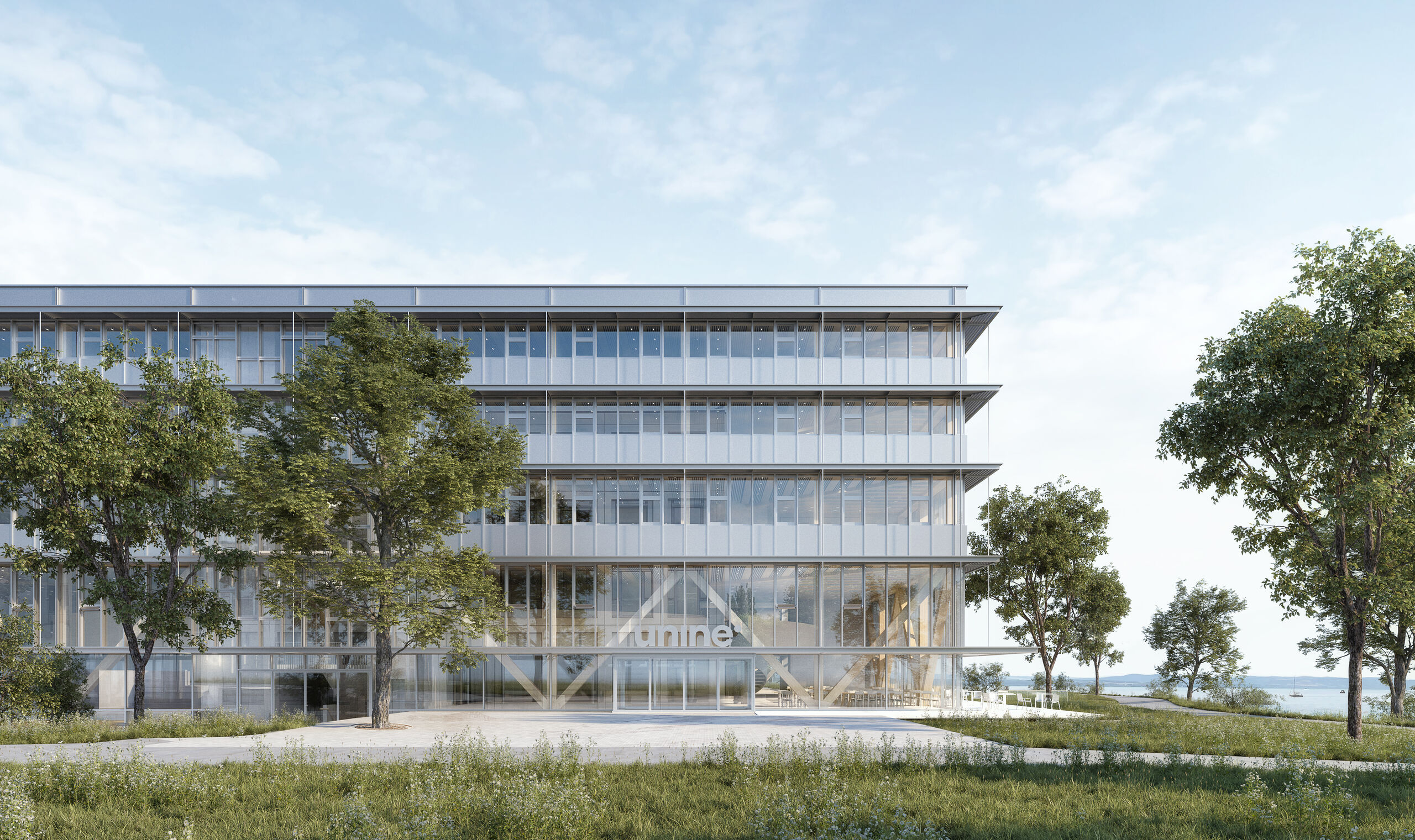
On a site on the shores of Lake Neuchâtel, the Université de Neuchâtel will gain a new focal point. Above all, it is intended to become a hub of university life, while also serving as an interface with the wider public. The currently underused site in this prime location will become a harbour of learning, progress, encounter, exchange and relaxation for everyone. The new building marks the end of an axis connecting the existing university buildings. This route culminates in a square in front of the main entrance to the Univers, an open space that establishes a visual relationship between the city and the lake.
The four façades of equal length open equally in all four directions. There is no front or rear. The view from the Univers towards the lake is given equal importance to the views towards the city and the neighbouring buildings. The interior reflects the same all-sidedness. In plan, a cross-shaped axis is superimposed on the square, with a circulation core rising at each of its four ends. On the ground floor, the double-height hall running along the façade is divided into four areas by the staircases. These quadrants accommodate the main zones of the Learning Center: the entrance hall, cafeteria, lounge and workspaces. They flow seamlessly into one another and can be expanded or combined, or completely rearranged as required.
At the centre, a circular platform floats above the ground floor. Four spiral staircases lead to the first floor and an encircling gallery, which provides students with an additional learning and social space. Behind it, a divisible auditorium occupies the innermost part of the building, embodying the heart of the entire Univers.
On the second floor, the walls of the corridor leading to the auditorium are glazed. The classrooms are arranged along the façade. The high level of transparency across the entire teaching floor creates a strong sense of community among teachers and students.
The third and fourth floors are designed as ring-shaped structures around the atrium above the auditoriums. The offices are arranged in two layers with a central corridor. The inner layer overlooks the courtyard, where a cross-shaped metal structure is covered with climbing plants.